Run your discipline · Lead & top rope
Lead and top rope
Lead and top rope share the same core job: set up categories and routes, make sure judges score the right athlete in the right order, then review results before publishing. This page covers the lead-specific flow.
Set up the lead competition
Route consistency
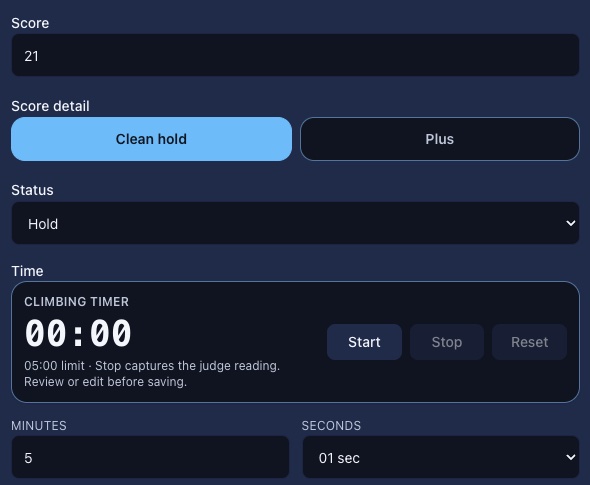
Judging by height / hold
Hold Number
Plus vs Clean
Top
Athlete order
Qualification sessions and running order
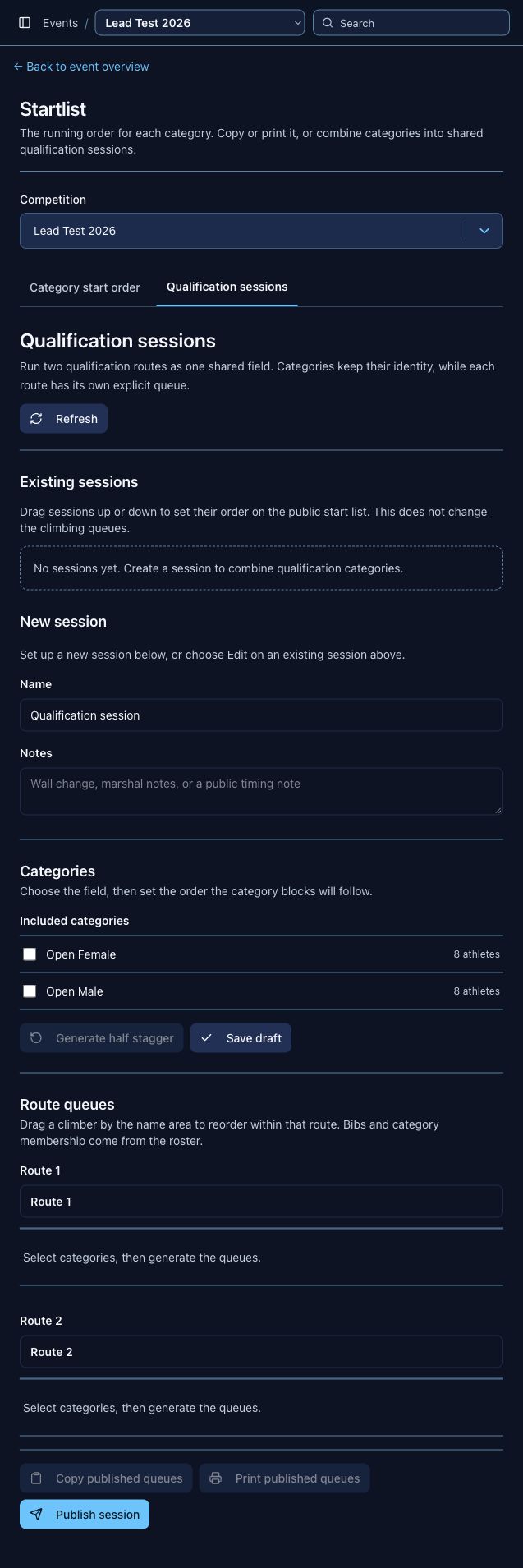
Open Lead Startlist. Category start order shows the two route queues; Route 2 uses a half-field stagger. Qualification sessions combines selected categories into a shared field while preserving category membership.
- 1In Qualification sessions, name the session, select its categories, and review their block order.
- 2Use Generate half stagger, then inspect both route queues. Save draft and Publish session are separate controls; check the published queues before judging.
- 3Drag existing session cards and use Save public order to change their public display order. This does not change the climbing queues.
- 4Once scoring has begun, use the supported Edit remaining order amendment flow for unscored climbers, with a reason. Have the chief review the change; do not regenerate scored queues.
Rounds and advancing
Use Lead Chief → Rounds → Advance To Finals for the intended category, after the chief verifies qualification.
- 1Check the category cutline and advancing field. Categories with finals disabled cannot advance.
- 2Every required qualification route needs a submitted result or an explicit DNS. A missing entry is not the same as a judged DNS; resolve the listed missing submissions before retrying.
- 3Review the confirmation before advancing. Then verify the final startlist, judge round, and public page separately. The round change can succeed while public startlist publishing fails; do not assume publication succeeded from the round change alone.
Results, scorecards, and exports
Lead qualification uses QP: the square root of the product of the athlete’s ranks on the two routes. Lower QP is better.
- 1Within each route, TOP ranks above numbered holds, and a plus ranks above the same hold without a plus. Equal scores share the average of their occupied positions.
- 2Multiply the two route ranks and take the square root. For example, route ranks 2 and 8 give QP 4; the ranks are not added together.
- 3If QP is equal, the current implementation compares Route 1 rank, then Route 2 rank. Equal comparisons remain tied. Review pending entries separately from submitted DNS before approving the qualification standings.
Exports and paper records
Review the final standings with the chief and check the public hub separately. Publishing is not a blanket lock on the source scores or startlist.